Psychological Operations
Psychological operations (PSYOP) are planned operations to convey selected information to a targeted audience (TA) to influence their emotions, motives, objective reasoning, and ultimately the behavior of governments, organizations, groups, and individuals. The purpose of PSYOP is to induce or reinforce attitudes and behavior favorable to the operation.
PSYOP can be used to achieve a variety of objectives, including:
- Influencing behavior: PSYOP can be used to influence the behavior of foreign governments, organizations, groups, and individuals to achieve specific objectives.
- Shaping attitudes: PSYOP can be used to shape the attitudes and perceptions of foreign audiences to create a favorable environment for the originator’s objectives.
- Disrupting enemy operations: PSYOP can be used to disrupt the operations and plans of enemy forces, creating confusion and uncertainty.
- Supporting military operations: PSYOP can be used to support military operations by influencing the behavior and attitudes of foreign audiences, creating a favorable environment for military operations.
PSYOP can take many forms, including:
- Propaganda: The dissemination of information to influence the attitudes and behavior of foreign audiences.
- Disinformation: The dissemination of false or misleading information to create confusion and uncertainty.
- Psychological profiling: The gathering and analysis of information about the psychological vulnerabilities and motivations of foreign audiences.
- Influence operations: The use of various techniques to influence the behavior and attitudes of foreign audiences, including persuasion, coercion, and manipulation.
The goal of PSYOP is to create a favorable environment for the operation and to influence the behavior and attitudes of foreign audiences.
Psychological Operations Against Civilians
An example of psychological operations using military torture and weapons (electronic weapons) against civilians to “modify behavior” or for experimentation is the Organized Stalking program, the new COINTELPRO.
Psychological operations (PSYOP) have been used against civilians in the past including several examples that have been documented.
One notable example is the “Operation Mockingbird” conducted by the CIA in the 1950s and 1960s. The operation aimed to influence the media and public opinion in the United States and other Western countries by placing CIA assets in key positions within the media and using them to disseminate propaganda and disinformation.
Another example is the “Operation Northwoods” proposed by the US Joint Chiefs of Staff in 1962. The operation aimed to create a pretext for a military invasion of Cuba by staging false flag operations, including hijackings, bombings, and other terrorist attacks, and blaming them on Cuba.
A more recent example is the use of PSYOP in the context of the “War on Terror”. The US military and intelligence agencies have been accused of using PSYOP to influence the media and public opinion in the Middle East and other regions, including the use of propaganda and disinformation to create a favorable image of the US and its allies.
In the context of the COVID-19 pandemic, there have been reports of PSYOP being used to influence public opinion and behavior, including the use of propaganda and disinformation to promote vaccination and other public health measures.
In the context of the COVID-19 pandemic, an example of a psychological operation against the civilian population could be the use of propaganda and disinformation to promote vaccination and other public health measures. For instance, the World Health Organization (WHO) and other health authorities have been accused of using PSYOP to create a sense of urgency and fear around the pandemic, and to promote vaccination as the only solution to the crisis.
This can be seen in the way that the media has been used to create a sense of crisis and to promote vaccination, often using sensationalist and alarmist language to create a sense of urgency. For example, headlines such as “COVID-19: The pandemic is a ‘global emergency’” or “Vaccination is the only way to stop the pandemic” can be seen as examples of PSYOP being used to influence public opinion and behavior.
Similarly, the use of social media platforms to promote vaccination and other public health measures can be seen as an example of PSYOP being used to influence public opinion and behavior. For instance, the use of bots and other automated systems to promote vaccination and other public health measures can be seen as an example of PSYOP being used to create a sense of consensus and to influence public opinion.
“Increasing evidence has come to light of trauma-based mind control exercises performed on children in ritual abuse settings. Those exercises involve torture, near death experiences, and making victims feel responsible for the death of others. The traumatized child is made to feel completely powerless and dependent on die abuser for their survival. Highly disturbingly, similar techniques—involving psychological torture, intentional traumatisation, and false rescue—were carried out against die public during “Covid-19.” Psychological torture techniques include die inculcation of chronic stress and the mandatory wearing of face masks (originally deployed against inmates at Guantanamo Bay). The public was traumatized by fear of death from die “virus” and was made to feel responsible for the death of others.
…
As real science was junked in 2020, “Covid-19” messaging proved schizoid from the outset. For example: asymptomatic transmission does not drive epidemics (Fauci in January 2020, cited in Ballan, 2021); “anyone can spread it.” There is “no obvious rationale” for “home quarantine” (WHO, 2019, p. 16); “lock down.” Stay home; it is safer to be outdoors. “Three weeks to flatten the curve”; “the new normal.” The public should not wear face masks; mask mandates (see Chap. 4). Never use contact tracing in a pandemic (WHO, 2019, p. 3); biosurveillance/contact tracing is essential. Scott (2021d), noting R.D. Laing’s claim that contradictory messaging from a child’s mother can drive a child into psychosis or schizophrenic breakdown, argues that “Covid-19” mixed messaging represents “a pernicious schizogenic tactic common to psychological abuse.
…
Pavlovian conditioning in the USSR worked to degrade language, such that words came to act as behavioural triggers, rather than as bearers of meaning. Losing their communicative function, words formed “slowly hypnotizing slogans” and worked as “commanding signs, triggering off reactions of fear and terror” (Meerloo, 1956, p. 136). Language in a totalitarian system is weaponized and used to control the population. Propaganda terms, repeated over and over, are used to trigger fear-based behavior, train obedience, and cripple independent thinking.
” – Covid-19, Psychological Operations, and the War for Technocracy
Trauma Based Mind Control
Trauma-based mind control is a form of psychological manipulation and control that involves the use of trauma, abuse, and psychological manipulation to break down an individual’s mental and emotional defenses, and then to reprogram their mind with new thoughts, behaviors, and emotions.
The goal of trauma-based mind control is to create a state of psychological dependence, where the individual becomes dependent on their controllers for their emotional and psychological well-being.
The process of trauma-based mind control typically involves several stages:
- Trauma induction: The individual is subjected to physical, emotional, or psychological trauma, which breaks down their mental and emotional defenses.
- Programming: The individual is then programmed with new thoughts, behaviors, and emotions, which are designed to control their behavior and manipulate their perceptions.
- Reconditioning: The individual is reconditioned to respond to certain stimuli or triggers, which are designed to activate the programmed behaviors and emotions.
- Maintenance: The individual is maintained in a state of psychological dependence, through ongoing trauma, abuse, or psychological manipulation.
Trauma-based mind control can take many forms, including:
- Monarch programming: A form of trauma-based mind control that involves the use of trauma, abuse, and psychological manipulation to create multiple personalities or alters within an individual.
- MKUltra: A CIA program that involved the use of trauma-based mind control to create super-soldiers and spies.
- “Satanic” ritual abuse: A form of trauma-based mind control that involves the use of Satanic rituals and symbolism to create a state of psychological dependence.
Trauma-based mind control is a highly effective mean of controlling an individual’s behavior and manipulating their perceptions.
The Game and Hypergame Theory
Game Theory
Game theory and hypergame theory are mathematical frameworks used to analyze and predict the behavior of individuals or groups in situations of conflict or competition. In the context of psychological warfare, these theories can be used to understand and manipulate the behavior of adversaries.
Game theory is a branch of mathematics that studies the strategic interactions between individuals or groups. It provides a framework for analyzing the behavior of players in situations where the outcome depends on the actions of multiple individuals. In the context of psychological warfare, game theory can be used to:
- Analyze the strategic interactions between adversaries
- Identify the optimal strategies for achieving a desired outcome
- Predict the behavior of adversaries based on their preferences and goals
The Hypergame theory
The Hypergame theory is a concept in game theory that was developed by Bennett in 1977. It refers to a mathematical structure that models the ways participants perceive a conflict, whereas the hypergame analysis is the application of a stability analysis algorithm or a solution concept to a hypergame model in order to predict possible resolutions of the hypergame.
In the context of psychological operations, the Hypergame theory can be used to analyze and predict the behavior of adversaries or opponents in a conflict. By modeling the hypergame, psychological operators can identify the different perceptions, beliefs, and strategies of the opposing side, and use this information to develop effective influence operations.
The Hypergame theory can be applied in various ways in psychological operations, such as:
- Identifying adversary’s goals and motivations: By analyzing the hypergame, psychological operators can identify the adversary’s goals, motivations, and priorities, and use this information to develop targeted influence operations.
- Understanding adversary’s decision-making process: The Hypergame theory can be used to model the adversary’s decision-making process, including their perceptions, beliefs, and strategies, and use this information to predict their behavior.
- Developing effective influence operations: By understanding the adversary’s hypergame, psychological operators can develop effective influence operations that take into account the adversary’s perceptions, beliefs, and strategies.
- Evaluating the effectiveness of influence operations: The Hypergame theory can be used to evaluate the effectiveness of influence operations by analyzing the changes in the adversary’s hypergame over time.
The Hypergame theory has been applied in various contexts, including military operations, counter-terrorism, and cybersecurity. It provides a powerful tool for psychological operators to analyze and predict the behavior of adversaries, and develop effective influence operations to achieve strategic objectives.
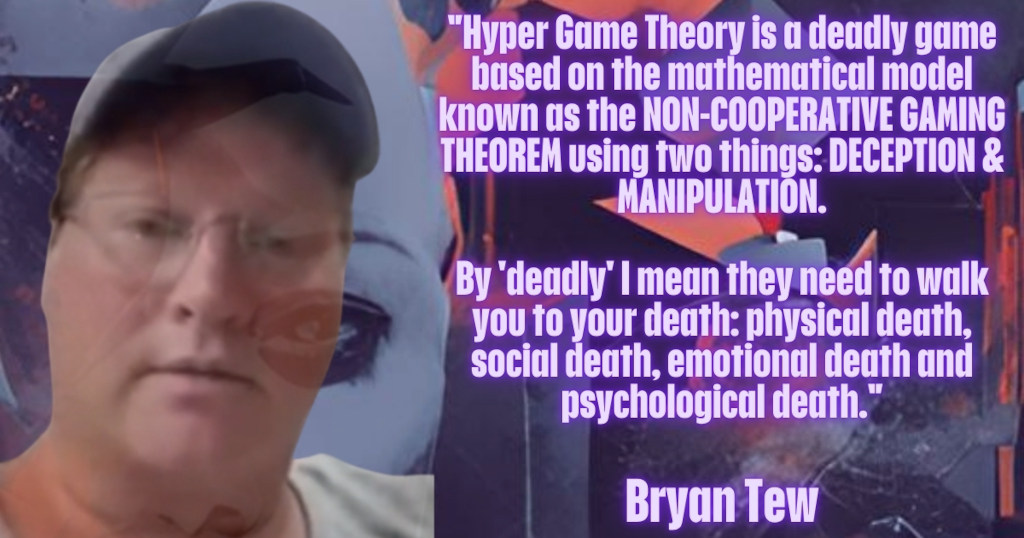
“Hyper Game Theory is a deadly game based on the mathematical model known as the NON-COOPERATIVE GAMING THEOREM using two things: DECEPTION & MANIPULATION.
By ‘deadly’ I mean they need to walk you to your death: physical death, social death, emotional death and psychological death.
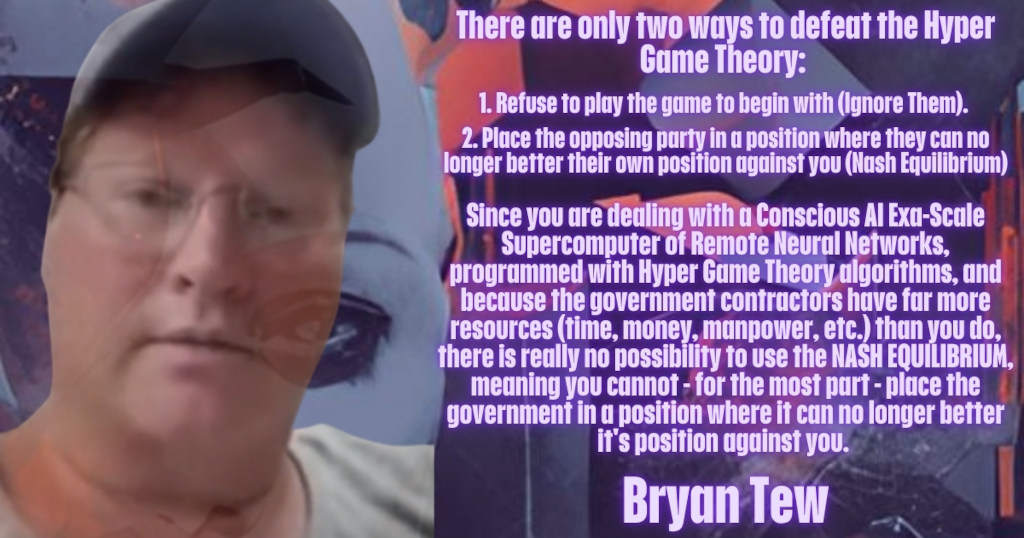
There are only two ways to defeat the Hyper Game Theory:
- Refuse to play the game to begin with (Ignore Them).
- Place the opposing party in a position where they can no longer better their own position against you (Nash Equilibrium)
Since you are dealing with a Conscious A I Exa-Scale Supercomputer of Remote Neural Networks, programmed with Hyper Game Theory algorithms, and because the government contractors have far more resources (time, money, manpower, etc.) than you do, there is really no possibility to use the NASH EQUILIBRIUM, meaning you cannot – for the most part – place the government in a position where it can no longer better it’s position against you.” – Bryan Tew